
Site view
Timeline
Every dated card across World War II Archive, arranged chronologically. Dates are inferred from each card's summary.


Era
1940s
12 cards

1940· Leaders
Winston Churchill
Sir Winston Leonard Spencer Churchill was a British statesman, military officer, and writer who was Prime Minister of the United Kingdom from 1940 to 1945, during the Second World War, and again from 1951 to 1955. For some 62 of the years between 1900 and 1964, he was a Member of Parliament (MP) and represented a total of five constituencies over that time. Ideologically an adherent to economic liberalism and imperialism, he was for most of his career a member of the Conservative Party, which he led from 1940 to 1955. He was a member of the Liberal Party from 1904 to 1924.

1940· Battles & Events
Battle of Britain
The Battle of Britain was a military campaign of the Second World War, in which the Royal Air Force (RAF) and the Fleet Air Arm (FAA) of the Royal Navy defended the United Kingdom against large-scale attacks by Nazi Germany's air force, the Luftwaffe. It was the first major military campaign fought entirely by air forces. It takes its name from the speech given by Prime Minister Winston Churchill to the House of Commons on 18 June, 1940: "What General Weygand called the 'Battle of France' is over. I expect that the Battle of Britain is about to begin."

1941· Battles & Events
The Holocaust
The Holocaust, known in Hebrew as the Shoah, was the genocide of European Jews during World War II. From 1941 to 1945, Nazi Germany and its collaborators systematically murdered around six million Jews across German-occupied Europe, approximately two-thirds of Europe's Jewish population. The murders were committed primarily through mass shootings across Eastern Europe and poison gas chambers in extermination camps, chiefly Auschwitz-Birkenau, Treblinka, Belzec, Sobibor, Chełmno and Majdanek death camps in occupied Poland. Concurrent Nazi persecutions killed millions of other non-Jewish civilians and prisoners of war (POWs); the term Holocaust is sometimes used to include the murder and persecution of non-Jewish groups, such as the Romani and Soviet POWs.
The Nazis developed their ideology based on racism and pursuit of "living space", and seized power in early 1933. Meant to force all German Jews to emigrate, regardless of means, the regime passed anti-Jewish laws, encouraged violence, and orchestrated a nationwide pogrom known as Kristallnacht in November 1938. After Germany's invasion of Poland in September 1939, occupation authorities began to establish ghettos to segregate Jews. Following the June 1941 invasion of the Soviet Union, 1.5 to 2 million Jews were murdered by German forces and local collaborators. The Nazis first targeted Jewish Red Army POWs and male civilians, but quickly escalated to murdering Jewish women and children.
By early 1942, following the Wannsee

1942· Battles & Events
Battle of Midway
The Battle of Midway was a major naval battle in the Pacific Theater of World War II that took place on 4–7 June 1942, six months after Japan's attack on Pearl Harbor and one month after the Battle of the Coral Sea. The Japanese Combined Fleet under the command of Isoroku Yamamoto suffered a decisive defeat by two carrier strike groups of the U.S. Pacific Fleet near Midway Atoll, about 1,300 mi northwest of Oahu. Yamamoto had intended to capture Midway and lure out and destroy the U.S. Pacific Fleet, especially the aircraft carriers which had escaped damage at Pearl Harbor.

1942· Battles & Events
Battle of Stalingrad
The Battle of Stalingrad was a major battle on the Eastern Front of World War II in which Nazi Germany and its Axis allies fought the Soviet Union for control of the city of Stalingrad in southern Russia. Marked by intense close-quarters combat and heavy civilian losses during aerial bombardment, the battle is considered the largest and deadliest urban battle in military history and the largest battle in World War II. By the end of the fighting, the German 6th Army had been destroyed, the 4th Panzer Army had suffered severe losses, and Army Group B was routed. The defeat ended Germany’s 1942 summer offensive and passed the strategic initiative on the Eastern Front to the Soviet Union. The Soviet victory at Stalingrad is generally regarded as the pivotal turning point of the European theatre of the war.

1944· Battles & Events
Normandy landings
The Normandy landings were the landing operations and associated airborne operations on 6 June 1944 of the Allied invasion of Normandy in Operation Overlord during the Second World War. Codenamed Operation Neptune and often referred to as D-Day, it is the largest seaborne invasion in history. The operation began the liberation of France and the rest of Western Europe, and laid the foundations for the Allied victory on the Western Front.

1945· Leaders
Adolf Hitler
Adolf Hitler (20 April 1889 – 30 April 1945) was an Austrian-born German politician who was dictator of Germany in the Nazi era, from 1933 until his suicide in 1945. He rose to power as the leader of the Nazi Party, becoming the chancellor of Germany in 1933 and then taking the title of Führer und Reichskanzler in 1934. Germany's invasion of Poland on 1 September 1939 under his leadership marked the outbreak of the Second World War. Throughout the ensuing conflict, Hitler was closely involved in the direction of German military operations and was central to the perpetration of the genocide of about six million Jews in the Holocaust as well as the deaths of millions of other victims.

1945· Leaders
Franklin D. Roosevelt
Franklin Delano Roosevelt, also known as FDR, was the 32nd president of the United States, serving from 1933 until his death in 1945. He is the longest-serving US president and the only one to have served more than two terms. His first two terms were centered on combating the Great Depression, while his third and fourth focused on US involvement in World War II. A member of the Democratic Party, Roosevelt served in the New York State Senate from 1911 to 1913 and as the 44th governor of New York from 1929 to 1932.
1945· Battles & Events
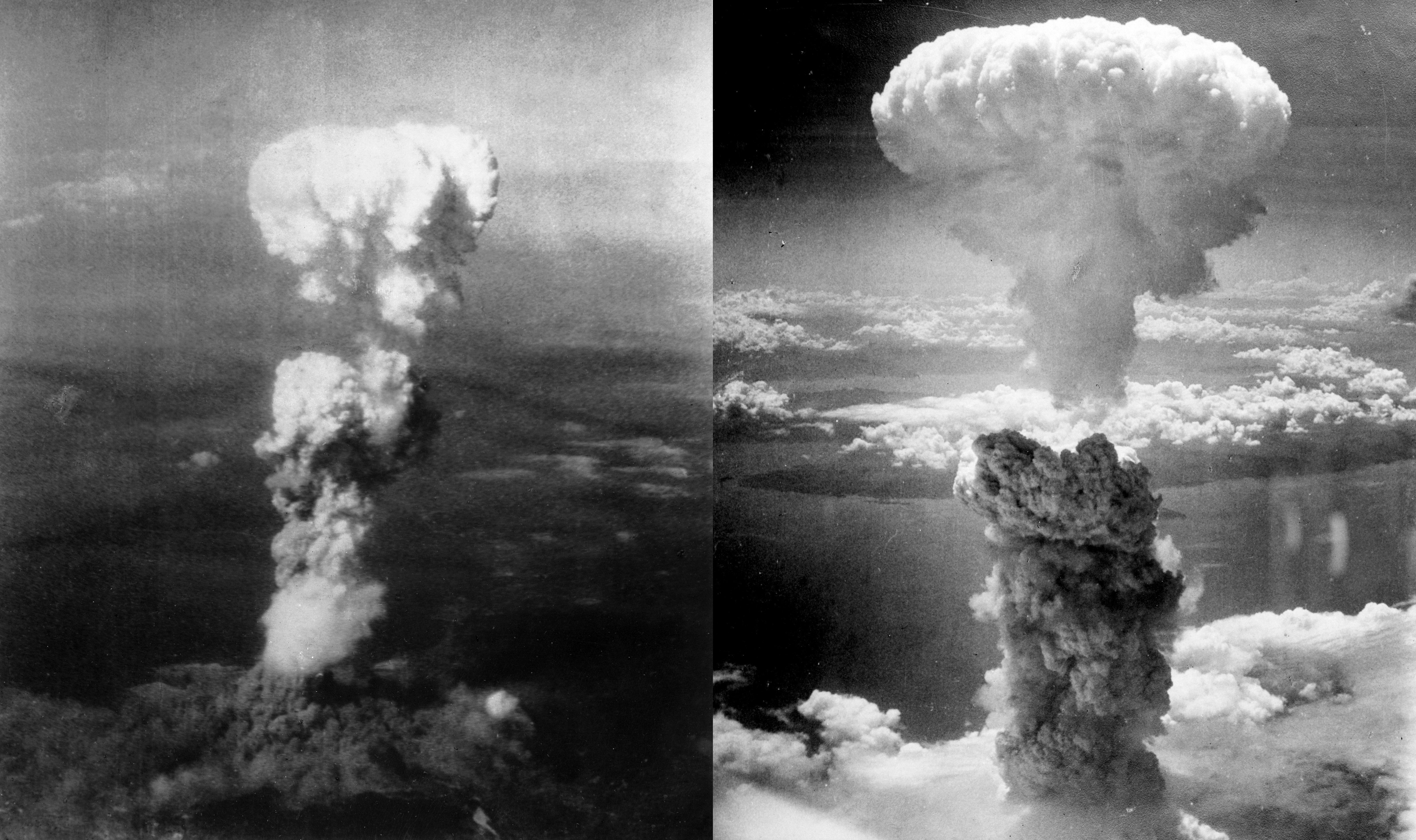
Atomic bombings of Hiroshima and Nagasaki
On 6 and 9 August 1945, the United States detonated two atomic bombs over the Japanese cities of Hiroshima and Nagasaki, respectively, during the final days of World War II. The aerial bombings killed 150,000 to 246,000 people, most of whom were civilians, and remain the first and only uses of nuclear weapons in an armed conflict.
In the final year of World War II, the Allies prepared for a costly invasion of the Japanese mainland. This undertaking was preceded by a conventional bombing and firebombing campaign that devastated 64 Japanese cities, including an operation on Tokyo. The war in Europe concluded when Germany surrendered on 8 May 1945, and the Allies turned their full attention to the Pacific War. By July 1945, the Allies' Manhattan Project had produced two types of atomic bombs: "Little Boy", an enriched uranium gun-type fission weapon, and "Fat Man", a plutonium implosion-type nuclear weapon. The 509th Composite Group of the U.S. Army Air Forces was trained and equipped with the specialized Silverplate version of the Boeing B-29 Superfortress, and deployed to Tinian in the Mariana Islands. The Allies called for the unconditional surrender of the Imperial Japanese Armed Forces in the Potsdam Declaration on 26 July 1945, the alternative being "prompt and utter destruction". The Japanese government ignored the ultimatum. Japan announced its surrender to the Allies on 15 August, six days after the bombing of Nagasaki and the Soviet Union's declaration of war against J
1945· Aftermath
United Nations
The United Nations (UN) is a global intergovernmental organization established by the signing of the Charter of the United Nations on 26 June 1945 with the articulated mission of maintaining international peace and security, to develop friendly relations among states, to promote international cooperation, and to serve as a centre for harmonizing the actions of states in achieving those goals.
The United Nations headquarters is located in New York City, with several other offices located in Geneva, Nairobi, Vienna and The Hague. The UN comprises six principal organizations: General Assembly, Security Council, Economic and Social Council, International Court of Justice, Secretariat and Trusteeship Council which, together with several specialized agencies and related agencies, make up the UN System. There are in total 193 member states, representing nearly all of the world's sovereign states, as well as two observer states, the Holy See and the State of Palestine.

1945· Aftermath
Iron Curtain
The Iron Curtain was the political and physical boundary that divided Europe from the end of World War II in 1945 until the end of the Cold War in 1990/1991. East of the Iron Curtain were many small states aligned with the Soviet Union, in 1955 formally allied by the Warsaw Pact. Many nations to the west of this geopolitical divide were NATO members. Over time these economic and military alliances developed into broader, more entrenched, cultural barriers; widespread distrust on both sides deepened. Initially, the term "Iron Curtain" was a literal description of physical barriers such as razor wire, fences, fortified walls, minefields, and watchtowers along the western border of the Eastern Bloc.
The term later took on a broader, metaphoric meaning perceived as a generalized "differentness" of ideology, economy, government, and way of life that emerged when the Cold War severed earlier cultural connections between European populations.

1948· Aftermath
Marshall Plan
The Marshall Plan was an American initiative enacted in 1948 to provide foreign aid to Western Europe. The United States transferred $13.3 billion to 17 European countries in economic recovery programs to Western European economies after the end of World War II in Europe. Replacing an earlier proposal for a Morgenthau Plan, it operated for four years beginning on April 3, 1948; though in 1951, the Marshall Plan was largely replaced by the Mutual Security Act. The goals of the United States were to rebuild war-torn regions, remove trade barriers, modernize industry, improve European prosperity and prevent the spread of communism. The Marshall Plan proposed the reduction of interstate barriers and the economic integration of the European continent while also encouraging an increase in productivity as well as the adoption of modern business procedures.

