Consoles
The Nintendo & Pokémon Archive

Section

Consoles

Every Nintendo console, big and small.

Cards

Nintendo DS

Nintendo DS

The Nintendo DS is a foldable handheld game console developed by Nintendo and released worldwide in 2004 and 2005. The "DS" in the name is an initialism for "Dual Screen", reflecting the system's most distinctive feature: two LCD screens working in tandem, with the lower screen functioning as a touchscreen. Both screens are housed in a clamshell design similar to that of the Game Boy Advance SP and some models of the Game & Watch series. The DS was among the first portable consoles to support wireless connectivity for local multiplayer over short distances, as well as online play through the now-defunct Nintendo Wi-Fi Connection service. Its primary competitor during the seventh generation of video game consoles was Sony's PlayStation Portable. Initially marketed as an experimental "third pillar" in Nintendo's console lineup—complementing the handheld Game Boy Advance family and the home console GameCube—the DS's backward compatibility with Game Boy Advance titles and strong sales led it to be widely regarded as the successor to the Game Boy line. A slimmer model, Nintendo DS Lite, which features brighter screens and improved battery life, was released in 2006. The DS and DS Lite were followed by the Nintendo DSi, a revision released on November 1, 2008. The DSi added dual digital cameras, larger screens, more memory, a faster processor, and internal flash memory, and it was later offered in a larger DSi XL model. It also introduced digital distribution of games, but lost com

Wii

Wii

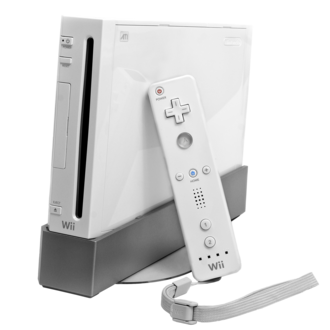
The Wii ( WEE) is a home video game console developed and marketed by Nintendo. It was released on November 19, 2006, in North America, and in December 2006 for most other regions of the world. It is Nintendo's fifth major home game console, following the GameCube, and is a seventh-generation console alongside Microsoft's Xbox 360 and Sony's PlayStation 3. The Nintendo president, Satoru Iwata, focused on appealing to a broader audience through innovative gameplay, rather than competing with Microsoft and Sony on raw computational power. Shigeru Miyamoto and Genyo Takeda led development, which was initially codenamed Revolution. The Wii emphasized new forms of interaction, particularly through its wireless controller, the Wii Remote, which featured motion-tracking controls and could recognize gestures and function as a pointing device. The Wii was Nintendo's first console with native Internet connectivity, enabling online gaming and digital distribution via the Wii Shop Channel. It also supported wireless connectivity with the handheld Nintendo DS console for select games. Early models were backward-compatible with GameCube games and accessories. Nintendo later released cheaper versions: the RVL-101, without GameCube compatibility, and the Wii Mini, which removed features such as online connectivity and SD card storage. Because of Nintendo's reduced focus on computational power, the Wii and its games were less expensive to produce than those of its competitors. It was extremel

Quiz

Quiz me on this collection

Sign in to take the quiz — your score is tracked on the Quiz Leaderboard.

Against the dead internet

Bots wrote the feed. Models ate the web. Wikipedia is one of the last human-made commons left — support the real internet.

Donate to Wikipedia →