
Site view
Timeline
Every dated card across Marvel Comics, arranged chronologically. Dates are inferred from each card's summary.
Era
1930s
4 cards
1938· Foundations and Era
Golden Age of Comic Books
The Golden Age of Comic Books describes an era in the history of American comic books from 1938 to 1956. During this time, modern comic books were first published and rapidly increased in popularity. The superhero archetype was created and many well-known characters were introduced, including Superman, Batman, Robin, Captain Marvel, Captain America, and Wonder Woman.
1939· Foundations and Era
Marvel Comics
Marvel Comics is an American comic book publisher, a property of the Walt Disney Company since December 31, 2009, and a subsidiary of Disney Publishing Worldwide since March 2023. Marvel was founded in 1939 by Martin Goodman as Timely Comics, and by 1951 had generally become known as Atlas Comics. The Marvel era began in August 1961 with the launch of The Fantastic Four and other superhero titles created by Stan Lee, Jack Kirby, Steve Ditko, and numerous others. The Marvel brand, which had been used over the years and decades, was solidified as the company's primary brand.
Marvel counts among its characters such well-known superheroes as Spider-Man, Wolverine, the Hulk, Captain America, Iron Man, Thor, Daredevil, Black Panther, Doctor Strange, and Captain Marvel, as well as popular superhero teams such as the Avengers, X-Men, Fantastic Four, and Guardians of the Galaxy. Its stable of well-known supervillains includes Doctor Doom, Magneto, Green Goblin, Kingpin, Red Skull, Loki, Ultron, Thanos, Apocalypse, and Galactus. Most of Marvel's fictional characters operate in a single reality known as the Marvel Universe, with most locations mirroring real-life places; many major characters are based in New York City. Additionally, Marvel has published several licensed properties from other companies. This includes Star Wars comics, twice from 1977 to 1987, and again since 2015.

1939· Foundations and Era
Timely Comics
Timely Comics was the common name for the group of corporations that was the earliest comic book arm of American publisher Martin Goodman, and the entity that would evolve by the 1960s to become Marvel Comics.
Founded in 1939, during the era called the Golden Age of Comic Books, "Timely" was the umbrella name for the comics division of pulp magazine publisher Goodman, whose business strategy involved having a multitude of corporate entities all producing the same product. The company's first publication in 1939 used Timely Publications, based at his existing company in the McGraw-Hill Building at 330 West 42nd Street in New York City. In 1942, it moved to the 14th floor of the Empire State Building, where it remained until 1951.
1939· Foundational Figures
Martin Goodman (publisher)
Martin Goodman was an American publisher of pulp magazines, digest sized magazines, paperback books, men's adventure magazines, and comic books, who founded the comics magazine company Timely Comics in 1939. Timely Comics would go on to become Marvel Comics, one of the United States' two largest comic book publishers along with rival DC Comics.
Era
1940s
2 cards

1940· Foundational Figures
Jack Kirby
Jack Kirby (; born Jacob Kurtzberg; August 28, 1917 – February 6, 1994) was an American comic book artist, widely regarded as one of the medium's major innovators and one of its most prolific and influential creators. He grew up in New York City and learned to draw cartoon figures by tracing characters from comic strips and editorial cartoons. He entered the nascent comics industry in the 1930s, drawing various comics features under different pen names, including Jack Curtiss, before settling on Jack Kirby. In 1940, he and writer-editor Joe Simon created the highly successful superhero character Captain America for Timely Comics, predecessor of Marvel Comics.

1940· Foundational Figures
Roy Thomas
Roy William Thomas Jr. (born November 22, 1940) is an American comic book writer and editor. He was Stan Lee's first successor as editor-in-chief of Marvel Comics and possibly best known for introducing the pulp magazine hero Conan the Barbarian to American comics. Thomas is also known for his championing of Golden Age comic-book heroes—particularly the 1940s superhero team the Justice Society of America—and for lengthy writing stints on Marvel's X-Men and The Avengers, and DC Comics' All-Star Squadron and Infinity Inc., among many other titles.
Era
1950s
4 cards

1950· Foundational Figures
Chris Claremont
Christopher Simon Claremont (born November 25, 1950) is an American comic book writer and novelist. Claremont worked for 16 years on Uncanny X-Men from 1975 to 1991, longer than that of any other writer, during which he is credited with developing strong female characters as well as introducing complex literary themes into superhero narratives, turning the once underachieving comic into one of Marvel's most popular series. During his tenure, X-Men was the best-selling comic book in the world.
During his tenure at Marvel, Claremont co-created dozens of X-Men characters. He wrote the stories "The Dark Phoenix Saga" and "Days of Future Past", on which he collaborated with John Byrne. He developed the character of Wolverine. X-Men #1, the 1991 spinoff series premiere that Claremont co-wrote with Jim Lee, is the bestselling comic book of all time, according to Guinness World Records. In 2015, Claremont and Byrne were entered into the Will Eisner Award Hall of Fame.
1950· Primary Protagonists
Captain America
Captain America is a superhero created by Joe Simon and Jack Kirby who appears in American comic books published by Marvel Comics. The character first appeared in Captain America Comics #1, published on December 20, 1940, by Timely Publications, a corporate predecessor to Marvel. Captain America's civilian identity is Steven "Steve" Rogers, a frail man rejected by the United States Army for physical unfitness who is enhanced to the peak of human physical perfection by an experimental "super-soldier serum". Equipped with an American flag–inspired costume and a virtually indestructible shield, Captain America and his sidekick Bucky Barnes clashed frequently with the villainous Red Skull and other agents of the Axis powers amid World War II. In the war's final days, an accident left Captain America frozen in a state of suspended animation until he was revived in modern times. He resumes his exploits as a costumed hero and becomes a leader of the superhero team the Avengers, while frequently struggling as a "man out of time" to adjust to the new era.
The character quickly emerged as Timely's most popular and commercially successful creation of the Golden Age of Comic Books, though the popularity of superheroes declined in the post-war period and Captain America Comics was discontinued in 1950. The character saw a short-lived revival in 1953 before returning to comics in 1964 and has since remained in continuous publication. Captain America's creation as an explicitly anti-Nazi fi

1951· Key Creators and Visionaries
Jim Shooter
James Charles Shooter (September 27, 1951 – June 30, 2025) was an American writer, editor and publisher in the comics industry. Beginning his career writing for DC Comics at the age of 14, he had a successful but controversial run as editor-in-chief at Marvel Comics, and launched comics publishers Valiant, Defiant, and Broadway.
1954· Foundations and Era
Silver Age of Comic Books
The Silver Age of Comic Books was a period of artistic advancement and widespread commercial success in mainstream American comic books, predominantly those featuring the superhero archetype. Following the Golden Age of Comic Books, the Silver Age is considered to cover the period from 1956 to 1970, and was succeeded by the Bronze Age of Comic Books.
The popularity and circulation of comic books about superheroes had declined following World War II, and comic books about horror, crime and romance took larger shares of the market. However, controversy arose over alleged links between comic books and juvenile delinquency, focusing in particular on crime, horror, and superheroes. In 1954, publishers implemented the Comics Code Authority to regulate comic content.
In the wake of these changes, publishers began introducing superhero stories again, a change that began with the introduction of a new version of DC Comics' The Flash in Showcase #4 (October 1956). In response to strong demand, DC began publishing more superhero titles including Justice League of America, which prompted Marvel Comics to follow suit beginning with The Fantastic Four #1.
A number of important comics writers and artists contributed to the early part of the era, including writers Stan Lee, Gardner Fox, John Broome, and Robert Kanigher, and artists Curt Swan, Jack Kirby, Gil Kane, Steve Ditko, Mike Sekowsky, Gene Colan, Carmine Infantino, John Buscema, Jim Steranko, and John Romita Sr. Silver Age comics have
Era
1960s
8 cards
1961· Major Teams and Factions
Fantastic Four
The Fantastic Four, often abbreviated as FF, is a superhero team appearing in American comic books published by Marvel Comics. The team debuted in The Fantastic Four #1 (cover-dated November 1961), helping usher in a new level of realism in the medium. It was the first superhero team created by artist/co-plotter Jack Kirby and editor/writer Stan Lee, and through this title the "Marvel method" style of production came into prominence.
The four regular members of the Fantastic Four, who gained superpowers after exposure to cosmic rays during a scientific mission to outer space, are Mister Fantastic (Reed Richards), a scientific genius and the leader of the group, who can stretch his body into incredible lengths and shapes; the Invisible Woman (Susan "Sue" Storm-Richards; originally the Invisible Girl), Reed's girlfriend and later wife, who can render herself or others invisible and later became able to project powerful invisible force fields and blasts; the Human Torch (Johnny Storm), Sue's younger brother, who can generate flames, surround himself with them and fly; and the monstrous Thing (Ben Grimm), their grumpy but benevolent friend, a former college football star, Reed's college roommate and a skilled pilot, who possesses tremendous superhuman strength, durability and endurance due to his stone-like flesh.
1962· Primary Protagonists
Iron Man
Iron Man is a superhero appearing in American comic books published by Marvel Comics. Co-created by writer and editor Stan Lee, developed by scripter Larry Lieber, and designed by artists Don Heck and Jack Kirby, the character first appeared in Tales of Suspense #39 in 1962 (cover dated March 1963) and received his own title with Iron Man #1 in 1968. Shortly after his creation, Iron Man became a founding member of the superhero team the Avengers, alongside Thor, Ant-Man, the Wasp, and the Hulk. Iron Man stories, individually and with the Avengers, have been published consistently since the character's creation.
Iron Man is the superhero persona of Anthony Edward "Tony" Stark, a businessman and engineer who runs the weapons manufacturing company Stark Industries. When Stark was captured in a war zone and sustained a severe heart wound, he built his Iron Man armor and escaped his captors. Iron Man's suits of armor grant him superhuman strength, flight, energy projection, and other abilities. The character was created in response to the Vietnam War as Lee's attempt to create a likeable pro-war character. Since his creation, Iron Man has been used to explore political themes, with early Iron Man stories being set in the Cold War. The character's role as a weapons manufacturer proved controversial, and Marvel moved away from geopolitics by the 1970s. Instead, the stories began exploring themes such as civil unrest, technological advancement, corporate espionage, alcoholism, and go
1962· Primary Protagonists
Hulk
The Hulk is a superhero appearing in American comic books published by Marvel Comics. Created by writer Stan Lee and artist Jack Kirby, the character first appeared in the debut issue of The Incredible Hulk (May 1962). In his comic book appearances, the character, who has dissociative identity disorder (DID), is primarily represented by the alter ego Hulk, an immense, green-skinned, hulking brute, possessing a limitless degree of physical strength, and the alter ego Dr. Robert Bruce Banner, a physically weak, socially withdrawn, and emotionally reserved physicist, both of whom typically resent each other. Lee stated that the Hulk's creation was inspired by a combination of Frankenstein and Dr. Jekyll and Mr. Hyde.
Following his accidental exposure to gamma rays while saving the life of Rick Jones during the detonation of an experimental bomb, Banner is physically transformed into the Hulk when subjected to emotional stress, at or against his will. This transformation often leads to destructive rampages and conflicts that complicate Banner's civilian life. The Hulk's level of strength is usually conveyed proportionate to his anger level. Commonly portrayed as a raging savage, the Hulk has been represented with other alter egos like a gangster (Joe Fixit), a merged personality (Merged Hulk), a mindless, destructive force (War), a brilliant warrior (World-Breaker), a self-hating protector (Devil Hulk), a genius scientist in his own right (Doc Green), and several minor alter ego
1962· Iconic Superheroes
Thor (Marvel Comics)
Thor Odinson is a superhero appearing in American comic books published by Marvel Comics, based on the Germanic god of the same name. Created by artist Jack Kirby, writer Stan Lee, and scripter Larry Lieber, the character first appeared in Journey into Mystery #83 (1962) and first received his own title with Thor #126 (1966). Comic books featuring Thor have been published across several volumes.
Thor is one of the gods of Asgard and the son of the Asgardian king Odin. In addition to his Asgardian strength and extended lifespan, Thor wields control over the weather, including rain and lightning. He also carries the enchanted hammer Mjolnir, that enhances his abilities and grants him the ability to fly. Thor was first introduced as the alter ego of surgeon Donald Blake, who acquired Thor's power, which was later revealed to be a fabrication by Thor's father. Thor has since assumed other human identities and sometimes ruled as king of Asgard.
Thor's cast of supporting characters includes his fellow Asgardians Odin, Sif, The Warriors Three, and Balder the Brave, as well as other allies such as Jane Foster, Beta Ray Bill, and Hercules. Thor's arch-nemesis is his adoptive brother Loki. Thor is a founding member of the superhero team the Avengers, and has played a significant role in Marvel crossover storylines, including "Avengers Disassembled" (2004), Siege (2010), "Fear Itself" (2011) and "The War of the Realms" (2019). Chris Hemsworth portrays the cinematic adaptation of Thor in
1962· Iconic Superheroes
Spider-Man
Spider-Man is a superhero in American comic books published by Marvel Comics. Created by writer-editor Stan Lee and artist Steve Ditko, he first appeared in the anthology comic book Amazing Fantasy #15 (August 1962) in the Silver Age of Comic Books. Widely regarded as one of the most popular and commercially successful superheroes, he has been featured in comic books, television shows, films, video games, novels, and plays.
Spider-Man is the secret identity of Peter Benjamin Parker, who was raised by his Aunt May and Uncle Ben in Queens, New York City, after the death of his parents.
1963· Major Teams and Factions
Avengers (comics)
The Avengers are a superhero team appearing in American comic books published by Marvel Comics, created by writer-editor Stan Lee and artist/co-plotter Jack Kirby. The team made its debut in The Avengers #1 (cover-dated September 1963). Labeled "Earth's Mightiest Heroes", the original Avengers consisted of Iron Man, Ant-Man, Hulk, Thor, and Wasp. Captain America was discovered trapped in ice in issue #4, and joined the group after they revived him.
1964· Major Teams and Factions
Sinister Six
The Sinister Six are a group of supervillains in American comic books published by Marvel Comics, mainly those featuring Spider-Man. The members are drawn from the character''''s list of enemies, with the original members forming the team in The Amazing Spider-Man Annual #1 (October 1964). Led by Doctor Octopus (introduced in issue #3), the team in its premiere followed swiftly the very early appearances of many of the most enduring members of Spider-Man''''s rogues gallery: the Vulture (issue #2), the Sandman (issue #4), Electro (issue #9), Mysterio (issue #13), and Kraven the Hunter (issue #15). While Doctor Octopus has generally remained its leader, the Sinister Six has had multiple variations of composition.
The team has been adapted into various forms of media, mainly in animated series and video games.
1968· Iconic Superheroes
Black Panther (character)
Black Panther is a superhero appearing in American comic books published by Marvel Comics. Created by writer-editor Stan Lee and artist Jack Kirby, the character first appeared in Fantastic Four #52. Born T'Challa, son of the previous Black Panther T'Chaka, he is the king and protector of the fictional African nation of Wakanda, a technologically advanced society sustained by deposits of the fictional metal vibranium. Along with enhanced abilities achieved through the Wakandan ritual of drinking the essence of the heart-shaped herb, T'Challa relies on his proficiency in science, expertise in his nation's traditions, rigorous physical training, hand-to-hand combat skills, and access to wealth and advanced Wakandan technology to combat his enemies. The character became a member of the Avengers in 1968, and has continued that affiliation off and on in subsequent decades.
Era
1970s
2 cards
1970· Major Teams and Factions
X-Men
The X-Men are a superhero team in American comic books published by Marvel Comics. Created by writer/editor Stan Lee and artist/co-plotter Jack Kirby, the team first appeared in The X-Men #1 (September 1963). Although initially cancelled in 1970 due to low sales, following its 1975 revival and subsequent direction under writer Chris Claremont, it became one of Marvel Comics's most recognizable and successful franchises. The X-Men title may refer to the superhero team itself, the eponymous comic series, or the broader franchise, which includes various solo titles and team books, such as the New Mutants, Excalibur, and X-Force.
In the Marvel Universe, mutants are humans born with a genetic trait called the X-gene, which grants them natural superhuman abilities, generally manifesting during puberty. Due to their differences from most humanity, mutants are subject to prejudice and discrimination; many X-Men stories feature social commentary on bigotry, justice, and other political themes. The X-Men have fought against various enemies, including villainous mutants, human bigots, supervillains, mystical threats, extraterrestrials, and evil artificial intelligences. In most iterations of the team, they are led by their founder, Charles Xavier / Professor X, a powerful telepath who runs a school for mutant children out of his mansion in Westchester, New York, which secretly is also the headquarters of the X-Men.
Their stories have frequently involved Magneto, a powerful mutant with c
1974· Iconic Superheroes
Wolverine (character)
Wolverine is a superhero appearing in American comic books published by Marvel Comics. The character first appeared in the comic book The Incredible Hulk #180 (1974) and is best known as a member of the superhero team the X-Men. Wolverine is the alias of James Howlett, a mutant born in Canada in the late 19th century. He possesses a range of superpowers including highly advanced self-healing abilities, a significantly prolonged lifespan, animal-keen senses, and retractable claws. His skeleton is reinforced with the unbreakable fictional metal adamantium, which he acquired after becoming an unwilling test subject in the Weapon X super soldier program. Wolverine is commonly depicted as a gruff loner susceptible to animalistic "berserker rages" who struggles to reconcile his humanity with his wild nature.
Era
1980s
2 cards
1982· Foundations and Era
Marvel Games
Marvel Games is the licensing brand for video games based on Marvel properties, and is also the video game division of Disney Interactive. Before the incorporation of Marvel Games, video games based on Marvel properties released between 1982 and 1985 were handled by Marvel Comics Group, with Marvel video games from 1986 to 1998 being handled by Marvel Entertainment Group, while video games based on Marvel properties prior to the incorporation of Marvel Games were handled directly by Marvel Enterprises.
1983· Foundations and Era
Marvel Age
Marvel Age was a promotional comic book-sized magazine from Marvel Comics published from 1983 to 1994. Basically a comic-length edition of the Bullpen Bulletins page, Marvel Age contained previews of upcoming Marvel comics, as well as interviews with comics professionals and other features, including occasional original comic strips. It is also notable for early work by Marvel writers such as Peter David and Kurt Busiek.
Era
2000s
2 cards

2004· Key Creators and Visionaries
Brian Michael Bendis
Brian Michael Bendis (; born August 18, 1967) is an American comic book writer and artist.
Starting with crime and noir comics, Bendis eventually moved to mainstream superhero work. While at Marvel Comics, Bendis worked with Bill Jemas and Mark Millar as the writer on the first book of the Ultimate Marvel imprint, Ultimate Spider-Man, which debuted in 2000. He relaunched the Avengers franchise with New Avengers in 2004, wrote the Marvel storylines "Avengers Disassembled" (2004–2005), "Secret War" (2004–2005), "House of M" (2005), "Secret Invasion" (2008), "Siege" (2010) and "Age of Ultron" (2013), and co-created the characters Riri Williams, Miles Morales, and Jessica Jones.
Bendis has won five Eisner Awards for both his creator-owned work and his work on various Marvel Comics books.
Though he has cited comic book writers such as Frank Miller and Alan Moore, Bendis' writing influences are less rooted in comics, drawing on the work of David Mamet, Richard Price, and Aaron Sorkin, whose dialogue, Bendis said, was "the best in any medium."
In addition to writing comics, Bendis has worked in television, video games and film. He has also taught courses on graphic novels at The University of Oregon and Portland State University. In 2014, Bendis wrote Words for Pictures: The Art and Business of Writing Comics and Graphic Novels, a book about comics published by Random House.
2006· Foundational Figures
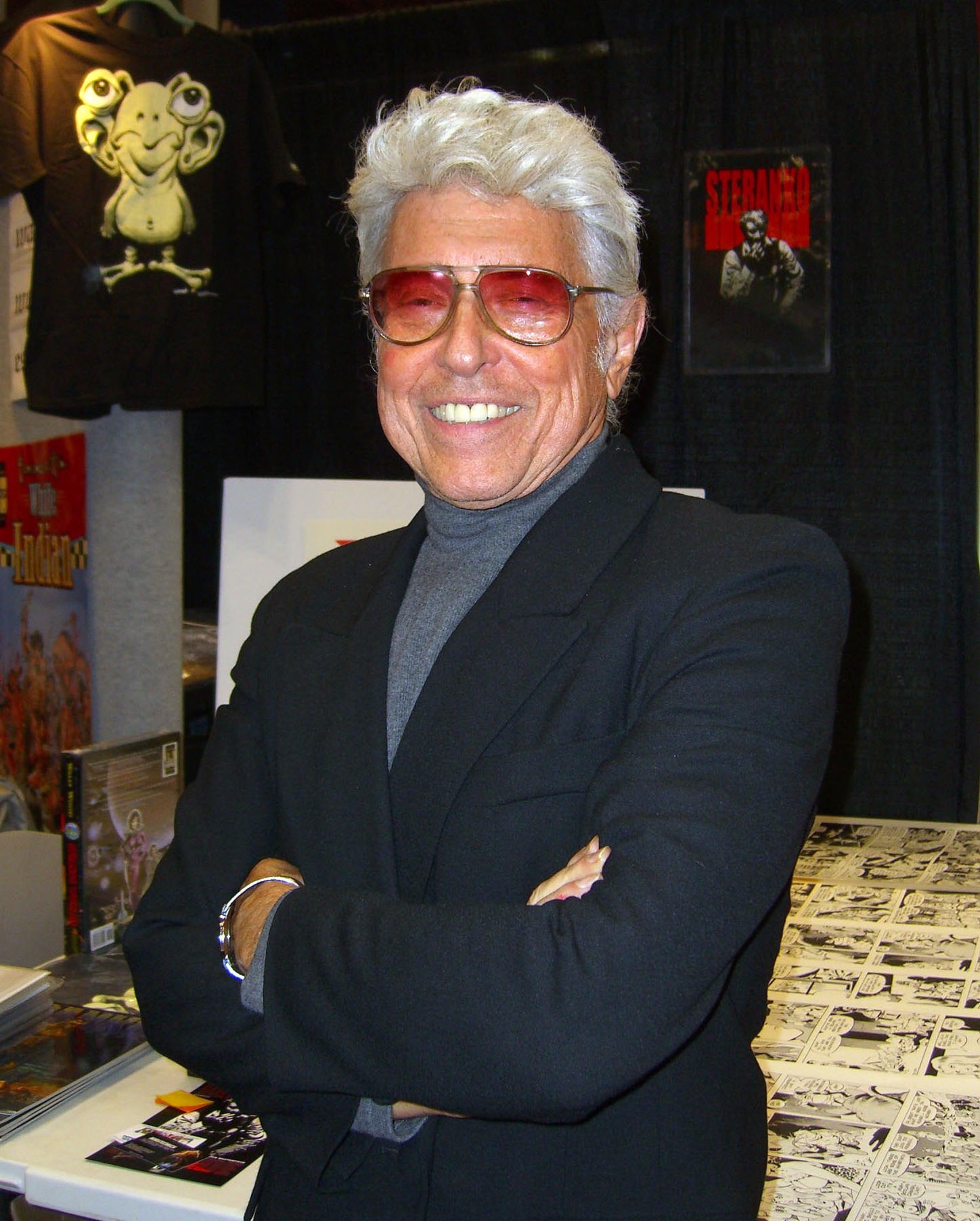
Jim Steranko
James F. Steranko (; born November 5, 1938) is an American graphic artist, comic book writer/artist, comics historian, magician, publisher and film production illustrator.
His most famous comic book work was with the 1960s superspy feature "Nick Fury, Agent of S.H.I.E.L.D." in Marvel Comics' Strange Tales and in the subsequent eponymous series. Steranko earned lasting acclaim for his innovations in sequential art during the Silver Age of Comic Books, particularly his infusion of surrealism, pop art, and graphic design into the medium. His work has been published in many countries and his influence on the field has remained strong since his comics heyday. He went on to create book covers, become a comics historian who published a pioneering two-volume history of the birth and early years of comic books, and to create conceptual art and character designs for films including Raiders of the Lost Ark and Bram Stoker's Dracula.
He was inducted into the comic-book industry's Will Eisner Comic Book Hall of Fame in 2006.
Era
2010s
3 cards

2010· Foundations and Era
Marvel Television
Marvel Television was an American television production company responsible for live-action and animated television shows and direct-to-DVD series based on characters from Marvel Comics. Marvel Television was formed as a division of Marvel Entertainment in June 2010, with producer Jeph Loeb serving as its executive vice president and head of television to produce shows for Marvel. The division was based at affiliate ABC Studios' location, and collaborated with the broadcast network ABC, streaming services Netflix and Hulu, and cable channel Freeform to release many of their series as a part of the Marvel Cinematic Universe (MCU) media franchise, a shared universe created by the film studio Marvel Studios. Animated series from Marvel Television were produced through Marvel Animation, and the division also collaborated with 20th Century Fox to produce shows based on the X-Men franchise such as Legion and The Gifted.

2013· Foundations and Era
Marvel Cinematic Universe
The Marvel Cinematic Universe (MCU) is an American media franchise and shared universe centered on a series of superhero films produced by Marvel Studios. The films are based on characters from American comic books published by Marvel Comics. The franchise also includes several television series, short films, digital series, and literature. The shared universe, much like the original Marvel Universe in comic books, was established by crossing over common plot elements, settings, cast, and characters.
Marvel Studios releases its films in groups called "Phases", with the first three phases collectively known as "The Infinity Saga" and the following three phases as "The Multiverse Saga". The first MCU film, Iron Man (2008), began Phase One, which culminated in the 2012 crossover film The Avengers. Phase Two began with Iron Man 3 (2013) and concluded with Ant-Man (2015), while Phase Three began with Captain America: Civil War (2016) and concluded with Spider-Man: Far From Home (2019). Black Widow (2021) is the first film in Phase Four, which concluded with Black Panther: Wakanda Forever (2022), while Phase Five began with Ant-Man and the Wasp: Quantumania (2023) and concluded with Thunderbolts* (2025). Phase Six began with The Fantastic Four: First Steps (2025) and will conclude with Avengers: Secret Wars (2027).
Marvel Television expanded the universe to television, first on network television with Agents of S.H.I.E.L.D. on ABC in 2013 before further expanding to streaming telev

2018· Foundational Figures
Stan Lee
Stan Lee (born Stanley Martin Lieber ; December 28, 1922 – November 12, 2018) was an American comic book writer, editor, publisher, and producer. He rose through the ranks of a family-run business called Timely Comics, which later became Marvel Comics. He was Marvel's primary creative leader for two decades, expanding it from a small publishing house division to a multimedia corporation that dominated the comics and film industries.
In collaboration with others at Marvel—particularly co-plotters and artists Jack Kirby and Steve Ditko—he co-created iconic characters, including Spider-Man, the X-Men, Iron Man, Thor, the Hulk, Ant-Man, the Wasp, the Fantastic Four, Black Panther, Daredevil, Doctor Strange, the Scarlet Witch, and Black Widow. These and other characters' introductions in the 1960s pioneered a more naturalistic approach in superhero comics. In the 1970s, Lee challenged the restrictions of the Comics Code Authority, indirectly leading to changes in its policies. In the 1980s, he pursued the development of Marvel properties in other media, with mixed results.
Following his retirement from Marvel in the 1990s, Lee remained a public figurehead for the company. He frequently made cameo appearances in films and television shows based on Marvel properties, on which he received an executive producer credit, which allowed him to become the actor with the highest-grossing film total ever. He continued independent creative ventures until his death, aged 95, in 2018. Lee was