
Site view
Timeline
Every dated card across The Elements Archive, arranged chronologically. Dates are inferred from each card's summary.


Era
1780s
2 cards

1781· Transition Metals
Tungsten
Tungsten is a chemical element; it has symbol W and atomic number 74. It is a metal found naturally on Earth almost exclusively in compounds with other elements. It was identified as a distinct element in 1781 and first isolated as a metal in 1783. Its important ores include scheelite and wolframite, the latter lending the element its alternative name.

1789· Transition Metals
Zirconium
Zirconium is a chemical element; it has symbol Zr and atomic number 40. First identified in 1789, isolated in impure form in 1824, and manufactured at scale by 1925, pure zirconium is a lustrous transition metal with a greyish-white color that closely resembles hafnium and, to a lesser extent, titanium. It is solid at room temperature, ductile, malleable and corrosion-resistant. The name zirconium is derived from the name of the mineral zircon, the most important source of zirconium. The word is related to Persian zargun. Besides zircon, zirconium occurs in over 140 other minerals, including baddeleyite and eudialyte; most zirconium is produced as a byproduct of minerals mined for titanium and tin.

Era
1810s
3 cards

1811· Reactive Nonmetals & Noble Gases
Iodine
Iodine is a chemical element; it has symbol I and atomic number 53. The heaviest of the stable halogens, it exists at standard conditions as a semi-lustrous, non-metallic solid that melts to form a deep violet liquid at 114 °C (237 °F), and boils to a violet gas at 184 °C (363 °F). The element was discovered by the French chemist Bernard Courtois in 1811 and was named two years later by Joseph Louis Gay-Lussac, after the Ancient Greek Ιώδης, meaning 'violet'.

1817· Reactive Nonmetals & Noble Gases
Selenium
Selenium is a chemical element; it has symbol Se and atomic number 34. It has various physical appearances, including a brick-red powder, a vitreous black solid, and a grey metallic-looking form. It seldom occurs in this elemental state or as pure ore compounds in Earth's crust. Selenium was discovered in 1817 by Jöns Jacob Berzelius, who noted the similarity of the new element to the previously discovered tellurium.

1817· Transition Metals
Cadmium
Cadmium is a chemical element; it has symbol Cd and atomic number 48. This soft, silvery-white metal is chemically similar to the two other stable metals in group 12, zinc and mercury. Like zinc, it demonstrates oxidation state +2 in most of its compounds, and like mercury, it has a lower melting point than the transition metals in groups 3 through 11. Cadmium and its congeners in group 12 are often not considered transition metals, in that they do not have partly filled d or f electron shells in the elemental or common oxidation states. The average concentration of cadmium in Earth's crust is between 0.1 and 0.5 parts per million (ppm). It was discovered in 1817 simultaneously by Stromeyer and Hermann, both in Germany, as an impurity in zinc carbonate.

Era
1860s
3 cards
1861· Post-Transition Metals & Metalloids
Thallium
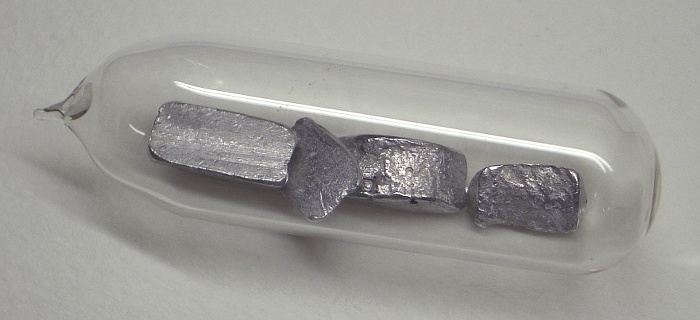
Thallium is a chemical element; it has symbol Tl and atomic number 81. It is a silvery-white post-transition metal that is not found free in nature. When isolated, thallium resembles tin, but discolors when exposed to air. Chemists William Crookes and Claude-Auguste Lamy discovered thallium independently in 1861, in residues of sulfuric acid production. Both used the newly developed method of flame spectroscopy, in which thallium produces a notable green spectral line. Thallium, from Greek θαλλός, thallós, meaning "green shoot" or "twig", was named by Crookes. It was isolated by both Lamy and Crookes in 1862, Lamy by electrolysis and Crookes by precipitation and melting of the resultant powder. Crookes exhibited it as a powder precipitated by zinc at the International Exhibition, which opened on 1 May that year.

1863· Post-Transition Metals & Metalloids
Indium
Indium is a chemical element; its symbol is In and its atomic number is 49. It is a silvery-white post-transition metal and one of the softest elements. Chemically, indium is similar to gallium and thallium, and its properties are largely intermediate between the two. It was discovered in 1863 by Ferdinand Reich and Hieronymous Theodor Richter by spectroscopic methods and named for the indigo blue line in its spectrum.
1869· Transition Metals
Hafnium
Hafnium is a chemical element; it has symbol Hf and atomic number 72. A lustrous, silvery gray, tetravalent transition metal, hafnium chemically resembles zirconium and is found in many zirconium minerals. Its existence was predicted by Dmitri Mendeleev in 1869, though it was not identified until 1922, by Dirk Coster and George de Hevesy. Hafnium is named after Hafnia, the Latin name for Copenhagen, where it was discovered. The element is obtained only by separation from zirconium, with most of the world's hafnium production coming from processes that also produce zirconium. These processes make use of heavy mineral sands ore deposits, which include the minerals zircon, rutile, and ilmenite, among others.
Era
1870s
2 cards

1875· Post-Transition Metals & Metalloids
Gallium
Gallium is a chemical element; it has symbol Ga and atomic number 31. Discovered by the French chemist Paul-Émile Lecoq de Boisbaudran in Paris, France, 1875,
elemental gallium is a soft, silvery metal at standard temperature and pressure with a complex orthorhombic crystal structure. In its liquid state, it becomes silvery white. If enough force is applied, solid gallium may fracture conchoidally. Gallium does not occur as a free element in nature, but rather as gallium(III) compounds in trace amounts in zinc ores and in bauxite.

1879· Transition Metals
Scandium
Scandium is a chemical element; it has symbol Sc and atomic number 21. It is a silvery-white metallic element found in the d-block of the periodic table. Usually, it is classified as a rare-earth element, together with yttrium and the lanthanides. It was discovered in 1879 by spectral analysis of the minerals euxenite and gadolinite from Scandinavia.

Era
1890s
2 cards

1896· Lanthanides & Actinides
Europium
Europium is a chemical element; it has symbol Eu and atomic number 63. It is a silvery-white metal of the lanthanide series that reacts readily with air to form a dark oxide coating. Europium is the most chemically reactive, least dense, and softest of the lanthanides. It is soft enough to be cut with a knife. Europium was discovered in 1896, provisionally designated as Σ; in 1901, it was named after the continent of Europe. Europium usually assumes the oxidation state +3, like other members of the lanthanide series, but compounds having oxidation state +2 are also common. All europium compounds with oxidation state +2 are slightly reducing due to their tendency to get oxidised into the more stable +3 state. It has no significant biological role but is relatively non-toxic compared to other heavy metals. Most applications of europium exploit the phosphorescence of europium compounds. Europium is one of the rarest of the rare-earth elements on Earth.

1898· Alkali & Alkaline Earth Metals
Radium
Radium is a chemical element; it has symbol Ra and atomic number 88. It is the sixth element in group 2 of the periodic table, also known as the alkaline earth metals. Pure radium is silvery-white, but it readily reacts with nitrogen (rather than oxygen) upon exposure to air, forming a black surface layer of radium nitride (Ra3N2). All isotopes of radium are radioactive, the most stable isotope being radium-226 with a half-life of 1,600 years. When radium decays, it emits ionizing radiation as a by-product, which can excite fluorescent chemicals and cause radioluminescence. For this property, it was widely used in self-luminous paints following its discovery. Of the radioactive elements that occur in quantity, radium is considered particularly toxic, and it is carcinogenic due to the radioactivity of both it and its immediate decay product radon as well as its tendency to accumulate in the bones.
Radium, in the form of radium chloride, was discovered by Marie and Pierre Curie in 1898 from ore mined at Jáchymov. They extracted the radium compound from uraninite and published the discovery at the French Academy of Sciences five days later. Radium was isolated in its metallic state by Marie Curie and André-Louis Debierne through the electrolysis of radium chloride in 1910, and soon afterwards the metal started being produced on larger scales in Austria, the United States, and Belgium. However, the amount of radium produced globally has always been small in comparison to other el

Era
1940s
2 cards
1944· Lanthanides & Actinides
Curium
Curium is a synthetic chemical element; it has symbol Cm and atomic number 96. This transuranic actinide element was named after eminent scientists Marie and Pierre Curie, both known for their research on radioactivity. Curium was first intentionally made by the team of Glenn T. Seaborg, Ralph A. James, and Albert Ghiorso in 1944, using the cyclotron at Berkeley. They bombarded the newly discovered element plutonium with alpha particles. This was then sent to the Metallurgical Laboratory at the University of Chicago where a tiny sample of curium was eventually separated and identified. The discovery was kept secret until after the end of World War II. The news was released to the public in November 1947. Most curium is produced by bombarding uranium or plutonium with neutrons in nuclear reactors – one tonne of spent nuclear fuel contains ~20 grams of curium.
1949· Lanthanides & Actinides
Berkelium
Berkelium is a synthetic chemical element; it has symbol Bk and atomic number 97. It is a member of the actinide and transuranium element series. It is named after the city of Berkeley, California, the location of the Lawrence Berkeley National Laboratory where it was discovered in December 1949. Berkelium was the fifth transuranium element discovered after neptunium, plutonium, curium and americium.

Era
1990s
5 cards
1994· Superheavy Synthetics
Darmstadtium
Darmstadtium is a synthetic chemical element; it has symbol Ds and atomic number 110. It is extremely radioactive: the most stable known isotope, darmstadtium-281, has a half-life of approximately 14 seconds. Darmstadtium was first created in November 1994 by the GSI Helmholtz Centre for Heavy Ion Research in Darmstadt, Germany, after which it was named.
1994· Superheavy Synthetics
Roentgenium
Roentgenium is a synthetic chemical element; it has symbol Rg and atomic number 111. It is extremely radioactive and can only be created in a laboratory. The most stable known isotope, roentgenium-282, has a half-life of 130 seconds, although the unconfirmed roentgenium-286 may have a longer half-life of about 10.7 minutes. Roentgenium was first created in December 1994 by the GSI Helmholtz Centre for Heavy Ion Research near Darmstadt, Germany. It is named after the physicist Wilhelm Röntgen, who discovered X-rays. Only a few roentgenium atoms have ever been synthesized, and they have no practical application.
1996· Superheavy Synthetics
Copernicium
Copernicium is a synthetic chemical element; it has symbol Cn and atomic number 112. Its known isotopes are extremely radioactive, and have only been created in a laboratory. The most stable known isotope, copernicium-285, has a half-life of approximately 30 seconds. Copernicium was first created in February 1996 by the GSI Helmholtz Centre for Heavy Ion Research near Darmstadt, Germany. It was named after the astronomer Nicolaus Copernicus on his 537th anniversary.
1997· Superheavy Synthetics
Meitnerium
Meitnerium is a synthetic chemical element; it has symbol Mt and atomic number 109. It is an extremely radioactive synthetic element. The most stable known isotope, meitnerium-278, has a half-life of 4.5 seconds, although the unconfirmed meitnerium-282 may have a longer half-life of 67 seconds. The element was first synthesized in August 1982 by the GSI Helmholtz Centre for Heavy Ion Research near Darmstadt, Germany, and it was named after the Austrian-Swedish nuclear physicist Lise Meitner in 1997.
1999· Superheavy Synthetics
Flerovium
Flerovium is a synthetic chemical element; it has symbol Fl and atomic number 114. It is an extremely radioactive, superheavy element, named after the Flerov Laboratory of Nuclear Reactions of the Joint Institute for Nuclear Research in Dubna, Russia, where the element was discovered in 1999. The lab's name, in turn, honours Russian physicist Georgy Flyorov. IUPAC adopted the name on 30 May 2012. The name and symbol had previously been proposed for element 102 (nobelium) but were not accepted by IUPAC at that time.
Era
2000s
2 cards
2002· Superheavy Synthetics
Oganesson
Oganesson is a synthetic chemical element; it has symbol Og and atomic number 118. It was first synthesized in 2002 at the Joint Institute for Nuclear Research (JINR) in Dubna, near Moscow, Russia, by a joint team of Russian and American scientists. In December 2015, it was recognized as one of four new elements by the Joint Working Party of the international scientific bodies IUPAC and IUPAP. It was formally named on 28 November 2016. The name honors the nuclear physicist Yuri Oganessian, who played a leading role in the discovery of the heaviest elements in the periodic table.
2003· Superheavy Synthetics
Moscovium
Moscovium is a synthetic chemical element; it has symbol Mc and atomic number 115. It was first synthesized in 2003 by a joint team of Russian and American scientists at the Joint Institute for Nuclear Research (JINR) in Dubna, Russia. In December 2015, it was recognized as one of four new elements by the Joint Working Party of international scientific bodies IUPAC and IUPAP. On 28 November 2016, it was officially named after the Moscow Oblast, in which the JINR is situated.