Transition Metals
The Elements Archive

Section

Transition Metals

Cards

Iron

Iron

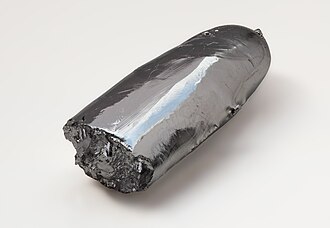
Iron is a chemical element; it has symbol Fe (from Latin ferrum 'iron') and atomic number 26. It is a metal that belongs to the first transition series and group 8 of the periodic table. It is, by mass, the most common element on Earth, forming much of Earth's outer and inner core. It is the fourth most abundant element in the Earth's crust. In its metallic state it was mainly deposited by meteorites. Extracting usable metal from iron ores requires kilns or furnaces capable of reaching 1,500 °C (2,730 °F), about 500 °C (900 °F) higher than that required to smelt copper. Humans started to master that process in Eurasia during the 2nd millennium BC and the use of iron tools and weapons began to displace copper alloys – in some regions, only around 1200 BC. That event is considered the transition from the Bronze Age to the Iron Age. In the modern world, iron alloys, such as steel, stainless steel, cast iron and special steels, are by far the most common industrial metals, due to their mechanical properties and low cost. The iron and steel industry is thus very important economically, and iron is the cheapest metal, with a price of a few dollars per kilogram or pound. Pristine and smooth pure iron surfaces are a mirror-like silvery-gray. Iron reacts readily with oxygen and water to produce brown-to-black hydrated iron oxides, commonly known as rust. Unlike the oxides of some other metals that form passivating layers, rust occupies more volume than the metal and thus flakes off,

Cobalt

Cobalt

Cobalt is a chemical element; it has symbol Co and atomic number 27. As with nickel, cobalt is found in the Earth's crust only in a chemically combined form, save for small deposits found in alloys of natural meteoric iron. The free element, produced by reductive smelting, is a hard, lustrous, somewhat brittle, gray metal. Cobalt-based blue pigments (cobalt blue) have been used since antiquity for jewelry and paints, and to impart a distinctive blue tint to glass. The color was long thought to be due to the metal bismuth. Miners had long used the name kobold ore (German for goblin ore) for some of the blue pigment-producing minerals. They were so named because they were poor in known metals and gave off poisonous arsenic-containing fumes when smelted. In 1735, such ores were found to be reducible to a new metal (the first discovered since ancient times), which was ultimately named for the kobold. Today, cobalt is usually produced as a by-product of copper and nickel mining, but sometimes also from one of a number of metallic-lustered ores such as cobaltite (CoAsS). The Copperbelt in the Democratic Republic of the Congo (DRC) and Zambia yields most of the global cobalt production. World production in 2016 was 116,000 tonnes (114,000 long tons; 128,000 short tons) according to Natural Resources Canada, and the DRC alone accounted for more than 50%. In 2024, production exceeded 300,000 tons, of which DRC accounted for more than 80%. Cobalt is primarily used in lithium-ion batter

Quiz

Quiz me on this collection

Sign in to take the quiz — your score is tracked on the Quiz Leaderboard.

Against the dead internet

Bots wrote the feed. Models ate the web. Wikipedia is one of the last human-made commons left — support the real internet.

Donate to Wikipedia →