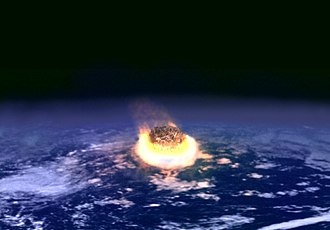


Permian–Triassic extinction event
The Permian–Triassic extinction event, colloquially known as the Great Dying, was an extinction event that occurred around the boundary between the Permian and Triassic geologic periods, and with them the Paleozoic and Mesozoic eras. It is Earth's most severe known extinction event, with the extinction of 57% of biological families, 62% of genera, 81% of marine species, and 70% of terrestrial vertebrate species. It is also the greatest known mass extinction of insects. It is the greatest of the "Big Five" mass extinctions of the Phanerozoic. There is evidence for one to three distinct pulses, or phases, of extinction, with the major pulse of marine extinction occurring in a 60,000-100,000 year interval around 251.902 million years ago (mya) marking the boundary between the Permian and Triassic periods. There is some controversy regarding the chronology of the extinctions on land and whether they are synchronous with the main marine extinction event.