
Site view
Timeline
Every dated card across Ancient Egypt Archive, arranged chronologically. Dates are inferred from each card's summary.
Era
Before 1 CE
7 cards
2890 BC· Religion & Myth
Anubis
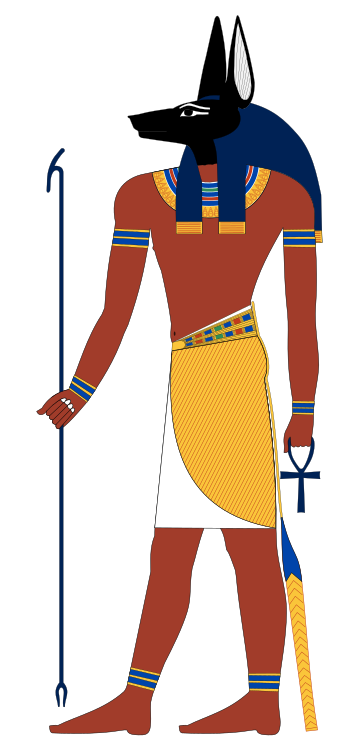
Anubis ( ; Ancient Greek: Ἄνουβις), also known as Inpu, Inpw, Jnpw, or Anpu in Ancient Egyptian (Coptic: ⲁⲛⲟⲩⲡ, romanized: Anoup), is the god of funerary rites, protector of graves, and guide to the underworld in ancient Egyptian religion, usually depicted as a canine or a man with a canine head.
Like many ancient Egyptian deities, Anubis assumed different roles in various contexts. Depicted as a protector of graves as early as the First Dynasty (c. 3100 – c. 2890 BC), Anubis was also an embalmer. By the Middle Kingdom (c. 2055–1650 BC) he was replaced by Osiris in his role as lord of the underworld. One of his prominent roles was as a god who ushered souls into the afterlife. He attended the weighing scale during the "Weighing of the Heart", in which it was determined whether a soul would be allowed to enter the realm of the dead. Anubis is one of the most frequently depicted and mentioned gods in the Egyptian pantheon; however, few major myths involved him.
Anubis was depicted in black, a color that symbolized regeneration, life, the soil of the Nile River, and the discoloration of the corpse after embalming. Anubis is associated with Wepwawet, another Egyptian god portrayed with a dog's head or in canine form, but with grey or white fur. Historians assume that the two figures were eventually combined. Anubis's female counterpart is Anput. His daughter is the serpent goddess Kebechet.

2600 BC· Monuments
Great Pyramid of Giza
The Great Pyramid of Giza is the largest of the Egyptian pyramids and the most famous landmark of the Giza pyramid complex in Giza, Egypt. It is the oldest of the Seven Wonders of the Ancient World, and the only wonder that has remained largely intact. The Great Pyramid served as the tomb of Egyptian Pharaoh Khufu ("Cheops"), who ruled during the Fourth Dynasty of the Old Kingdom. It was built c. 2600 BC over a period of about 26 years.

1479 BC· Pharaohs
Hatshepsut
Hatshepsut was the sixth pharaoh of the Eighteenth Dynasty of Egypt, ruling first as regent, then as queen regnant from c. 1479 BC until c. 1458 BC and the Great Royal Wife of Pharaoh Thutmose II. She was Egypt's second confirmed woman who ruled in her own right, the first being Sobekneferu/Neferusobek in the Twelfth Dynasty.
1334 BC· Pharaohs
Akhenaten
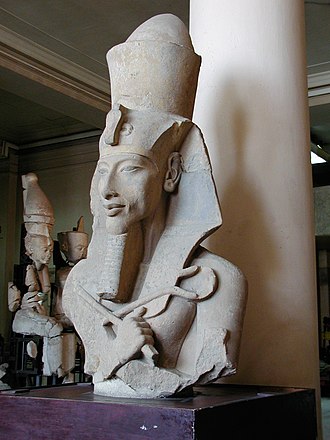
Akhenaten, also spelled Akhenaton, Echnaton, and Khuenaten, was an ancient Egyptian pharaoh reigning c. 1353–1336 or 1351–1334 BC, the tenth ruler of the Eighteenth Dynasty. Originally named Amenhotep IV, in the fifth year of his reign he adopted the name "Akhenaten".

1323 BC· Pharaohs
Tutankhamun
Tutankhamun or Tutankhamen, was the antepenultimate pharaoh of the Eighteenth Dynasty of ancient Egypt, who ruled c. 1332 – 1323 BC. Born Tutankhaten, he instituted the restoration of the traditional polytheistic form of ancient Egyptian religion, undoing a previous shift to the religion known as Atenism. Tutankhamun's reign is considered one of the greatest restoration periods in ancient Egyptian history, and his tomb door proclaims his dedication to illustrative constructions of the ancient Egyptian gods.
250 BC· Daily Life
Mummy
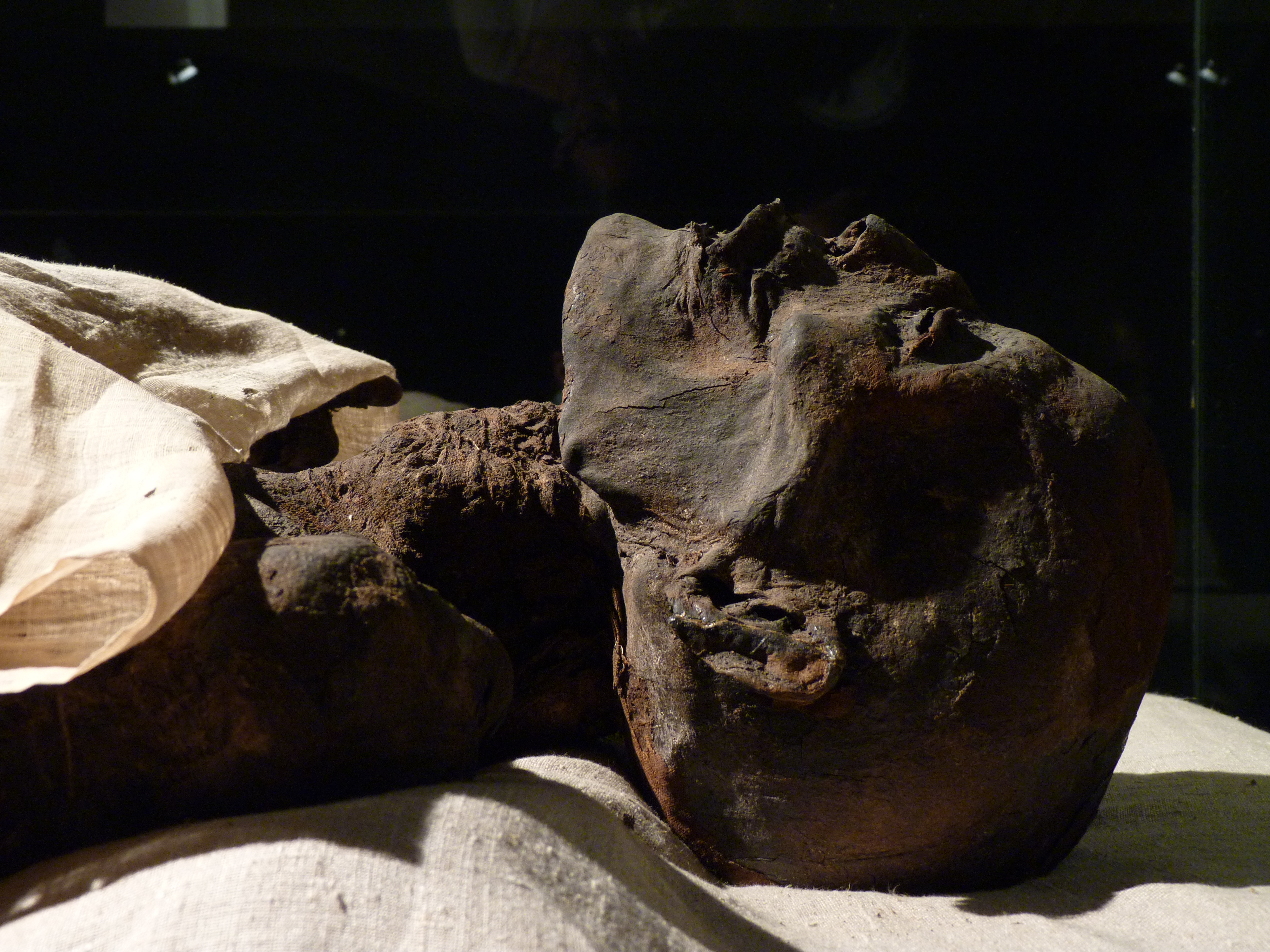
A mummy is a dead human or an animal whose soft tissues and organs have been preserved by either intentional or accidental exposure to chemicals, extreme cold, very low humidity, or lack of air, so that the recovered body does not decay further if kept in cool and dry conditions. Some authorities restrict the use of the term to bodies deliberately embalmed with chemicals, but the use of the word to cover accidentally desiccated bodies goes back to at least the early 17th century.
Mummies of humans and animals have been found on every continent, both as a result of natural preservation through unusual conditions, and as cultural artifacts. Over one million animal mummies have been found in Egypt, many of which are cats. Many of the Egyptian animal mummies are sacred ibis, and radiocarbon dating suggests the Egyptian ibis mummies that have been analyzed were from a time frame that falls between approximately 450 and 250 BC.
The earliest discovered evidence of deliberate mummification in human cultures now extends to approximately 10,000 B.C. and is documented to have existed across Southeast Asia, China, New Guinea, and Australia in burials discovered there, and is prompting research to cultures documented to 20,000 years ago for evidence of use of the same mummification methods.
In addition to the mummies of ancient Egypt, deliberate mummification was a feature of several ancient cultures in areas of America and Asia with very dry climates. The Spirit Cave mummies of Fallon,
196 BC· Daily Life
Rosetta Stone
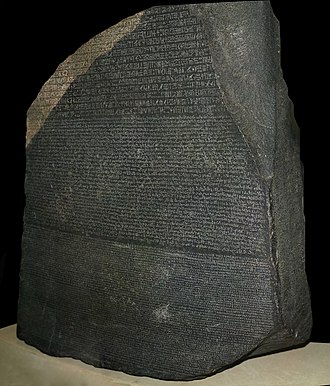
The Rosetta Stone is a stele of granodiorite inscribed with three versions of a decree issued in 196 BC during the Ptolemaic dynasty of Egypt, on behalf of King Ptolemy V Epiphanes. The top and middle texts are in Ancient Egyptian using hieroglyphic and Demotic scripts, respectively, while the bottom is in Ancient Greek. The decree has only minor differences across the three versions, making the Rosetta Stone key to deciphering the Egyptian scripts.


